DAME Design Awards 35 years - lessions from the founding winner
Author  Kim Hollamby
Kim HollambyMonday, 26 January 2026
In retrospect it should be no surprise to learn that the very first win of the DAME Design Awards was claimed by a world player on the consumer electronics scene. But, before we consider the reasons why Sony took top honours in 1991, let’s first set the scene.
In the 1980s and early 90s better equipped boats might also have a receiver for the Decca or Loran hyperbolic navigation systems, or even the US Transit satellite system with its infrequent fixes. But all of these had their quirks and variabilities requiring a level of skill and a healthy dose of scepticism for safest results.
The big change came with the introduction of the US Department of Defense Global Positioning System (GPS). The first-generation GPS constellation was launched between 1978-1993, with usage restricted to the military. In 1983 President Ronald Reagan authorised use by commercial airlines and that ultimately provided a path to wider civilian use. What we all needed though were GPS receivers capable of being used on leisure boats.
Enter the Magellan Systems Corporation, founded in 1986, which launched the world’s first commercially handheld GPS receiver two years later. Viewed today, the NAV1000 would be seen as large, underspecified and at €6600 equivalent cost today – expensive.
But it was a brilliantly conceived pioneer that no doubt would have factored highly had the DAME Design Awards been launched a couple of years earlier. For those who could afford it the rugged and buoyant Magellan placed reliable navigation into the hands of owners of even the smallest boats. A military version of the same unit arrived just in time for widespread use in the 1990-1991 Gulf War. By January 1991 Magellan quickly followed up by launching a PLUS model of the civilian NAV1000 with enhanced features for a current equivalent price of €4800.
Compared to higher priced GPS receivers from Magellan and another early GPS pioneer, Trimble Navigation, the very differently styled Sony had less functionality and a smaller screen. It was also not as rugged as the waterproof Magellan. But in many other ways, it did not look or feel like a half-price compromise.
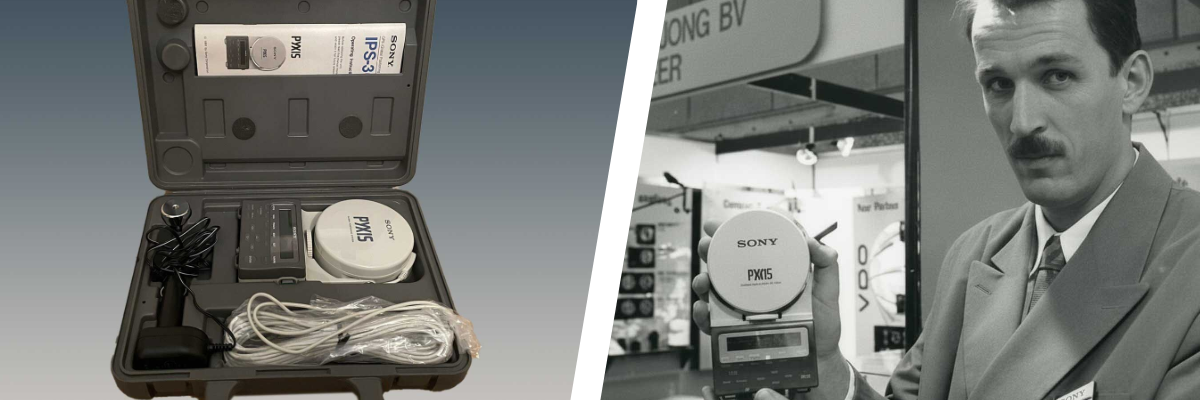
It helped that the PYXIS had Sony’s familiar and confidence inspiring logo displayed on its circular patch antenna and above the display of its connected control unit that was not much larger than a big pager. This, don’t forget, was an era where everyone was trying to figure out just how reliant they should be on a few satellites overhead talking to a handheld gadget.
The bold aesthetic of the IPS-360’s antenna and control unit combo served to reinforce that you had entered the space age of boat navigation. However, the design had a very functional application too. The antenna was easily demounted and could be placed remotely in locations where it could ‘see’ GPS satellites using a supplied extension cable as standard.
This was particularly important at a time when the first GPS constellation was incomplete, and you needed a minimum of three satellites for a real time fix. That meant it was often essential to receive signals in any direction from satellites that were low to the horizon so getting your antenna outdoors high and clear of obstructions made a significant difference to performance.
The IPS-360 was powered by four standard AA batteries or via an included 12V/24V power adapter. A neat moulded carrying case also contained a shoulder strap for the receiver and mounting hardware for the antenna and control unit. The well-designed user manual even had its own sleeve in the lid of the carry case.
Step-by-step instructions showed how to initialise the unit, change its settings, read the position and operate the rudimentary navigate system with its 50-waypoint memory. Sony’s service manual for the PYXIS offered circuit and wiring board diagrams and electrical parts lists to aid repair, something that enthusiast owners of this model used decades after Sony pulled out of the market.
Little would the DAME Jury of 1991 have known it, but the IPS-360 was to prove durable. And although environmental design was hardly on anyone’s agenda in 1991, the relative serviceability of this Sony model meant that many of them could continue in service even after its capacitors grew old and failed, causing the screen to go blank. There’s even an enthusiast YouTube video to show how to repair one.
To provide context, by 1993 the market was exploding, drawing in other major names such as Motorola, Panasonic and Icom; Magellan meanwhile had reduced the entry level to around €950 in current value with its Meridian and Trailblazer models.
Briefly scroll back to 1992 though and you also see the emergence of the first marine-focus handheld GPS unit from a 1989 start-up that enjoyed early success in avionics. The name, in case you hadn’t guessed it, was Garmin. Its GPS 50 was the start of a series of products that would rapidly expand and dominate the portable GPS navigator marketplace in the leisure marine sector.
It would be a pity though if our very first DAME Design Award winner was ever forgotten. The Sony PYXIS IPS-360’s place in the evolutionary path of marine electronic navigation was fleeting, but the self-styled ‘constellation compass’ deserves its place among the stars. If you want to see it for yourself, then look out for a special guest appearance on the DAME Design Awards exhibition at Metstrade on 17-19 November 2026.
We would very much like to hear the memories of anyone involved with nominated and winning entries over the years, particularly the overall winners. If you can help us, then please email dame@rai.nl or contact the author of this series, Kim Hollamby via LinkedIn. He’ll be pleased to get in touch.
A navigation revolution
As we approached the last decade of the 20th Century, navigation for the leisure sailor was still a relatively imprecise art and science. It relied heavily on traditional techniques honed over centuries. It might possibly be augmented with depth sounders, radio direction finding and radar if your yacht had one or more of those pieces of equipment.In the 1980s and early 90s better equipped boats might also have a receiver for the Decca or Loran hyperbolic navigation systems, or even the US Transit satellite system with its infrequent fixes. But all of these had their quirks and variabilities requiring a level of skill and a healthy dose of scepticism for safest results.
The big change came with the introduction of the US Department of Defense Global Positioning System (GPS). The first-generation GPS constellation was launched between 1978-1993, with usage restricted to the military. In 1983 President Ronald Reagan authorised use by commercial airlines and that ultimately provided a path to wider civilian use. What we all needed though were GPS receivers capable of being used on leisure boats.
Enter the Magellan Systems Corporation, founded in 1986, which launched the world’s first commercially handheld GPS receiver two years later. Viewed today, the NAV1000 would be seen as large, underspecified and at €6600 equivalent cost today – expensive.
But it was a brilliantly conceived pioneer that no doubt would have factored highly had the DAME Design Awards been launched a couple of years earlier. For those who could afford it the rugged and buoyant Magellan placed reliable navigation into the hands of owners of even the smallest boats. A military version of the same unit arrived just in time for widespread use in the 1990-1991 Gulf War. By January 1991 Magellan quickly followed up by launching a PLUS model of the civilian NAV1000 with enhanced features for a current equivalent price of €4800.
Enter the 1991 DAME winner
So far so good, but GPS receivers had yet to hit a price point closer to mass market wallets. That’s precisely where our very first DAME winner fits in. The Sony PYXIS IPS-360 was launched at Metstrade in 1991 at an equivalent price today of €2800, not exactly cheap but certainly more accessible and a good stepping stone towards more widespread adoption.Compared to higher priced GPS receivers from Magellan and another early GPS pioneer, Trimble Navigation, the very differently styled Sony had less functionality and a smaller screen. It was also not as rugged as the waterproof Magellan. But in many other ways, it did not look or feel like a half-price compromise.
It helped that the PYXIS had Sony’s familiar and confidence inspiring logo displayed on its circular patch antenna and above the display of its connected control unit that was not much larger than a big pager. This, don’t forget, was an era where everyone was trying to figure out just how reliant they should be on a few satellites overhead talking to a handheld gadget.
The bold aesthetic of the IPS-360’s antenna and control unit combo served to reinforce that you had entered the space age of boat navigation. However, the design had a very functional application too. The antenna was easily demounted and could be placed remotely in locations where it could ‘see’ GPS satellites using a supplied extension cable as standard.
This was particularly important at a time when the first GPS constellation was incomplete, and you needed a minimum of three satellites for a real time fix. That meant it was often essential to receive signals in any direction from satellites that were low to the horizon so getting your antenna outdoors high and clear of obstructions made a significant difference to performance.
The IPS-360 was powered by four standard AA batteries or via an included 12V/24V power adapter. A neat moulded carrying case also contained a shoulder strap for the receiver and mounting hardware for the antenna and control unit. The well-designed user manual even had its own sleeve in the lid of the carry case.
Step-by-step instructions showed how to initialise the unit, change its settings, read the position and operate the rudimentary navigate system with its 50-waypoint memory. Sony’s service manual for the PYXIS offered circuit and wiring board diagrams and electrical parts lists to aid repair, something that enthusiast owners of this model used decades after Sony pulled out of the market.
Setting an example for great design practices
In summary then, the IPS-360 was something of an exemplar for the holistic design practices that have been a hallmark of many DAME Design Award nominees and winners since. It fulfilled its objectives with an obvious focus on striking a good balance between price and performance. There was obvious attention to design in every detail, from aesthetics and function, including its packaging and manual. Despite the limitations of its small screen and form factor, it was relatively easy to use.Little would the DAME Jury of 1991 have known it, but the IPS-360 was to prove durable. And although environmental design was hardly on anyone’s agenda in 1991, the relative serviceability of this Sony model meant that many of them could continue in service even after its capacitors grew old and failed, causing the screen to go blank. There’s even an enthusiast YouTube video to show how to repair one.
What happened next?
Given its corporate might and promising start, you might have expected Sony to go on to dominate the handheld GPS market. Two years later the company launched the PYXIS IPS-760 retained a detachable antenna and featured a screen capable of being used as a chartplotter with a control layout that may well have influenced other manufacturers. But this was to be Sony’s last offering in the standalone GPS navigator market, except for a brief flirtation with in-car devices a few years later.To provide context, by 1993 the market was exploding, drawing in other major names such as Motorola, Panasonic and Icom; Magellan meanwhile had reduced the entry level to around €950 in current value with its Meridian and Trailblazer models.
Briefly scroll back to 1992 though and you also see the emergence of the first marine-focus handheld GPS unit from a 1989 start-up that enjoyed early success in avionics. The name, in case you hadn’t guessed it, was Garmin. Its GPS 50 was the start of a series of products that would rapidly expand and dominate the portable GPS navigator marketplace in the leisure marine sector.
It would be a pity though if our very first DAME Design Award winner was ever forgotten. The Sony PYXIS IPS-360’s place in the evolutionary path of marine electronic navigation was fleeting, but the self-styled ‘constellation compass’ deserves its place among the stars. If you want to see it for yourself, then look out for a special guest appearance on the DAME Design Awards exhibition at Metstrade on 17-19 November 2026.
What are your memories of the DAME Design Awards over the years?
For this special 35th anniversary year we are going to create a series of features in coming months looking at the winners – who they were, why they won and what they meant within the leisure marine sector.We would very much like to hear the memories of anyone involved with nominated and winning entries over the years, particularly the overall winners. If you can help us, then please email dame@rai.nl or contact the author of this series, Kim Hollamby via LinkedIn. He’ll be pleased to get in touch.